Your teeth do more than help you smile. They cut food, tear it and grind it into smaller pieces so you can eat comfortably. Learning the teeth names makes it easier to understand dental checkups, tooth charts, and the changes that happen as children grow.
In this guide, you will learn the four main types of teeth, where they sit, and what each one does. We will also explore the parts of a tooth, how many baby and mature person teeth people usually have, and when they appear. By the end, you will have a clear picture of your mouth and simple ways to care for it.
Table of Contents
- Types of Teeth Names
- Anatomy of a Tooth
- How Many Teeth Do Humans Have?
- Tooth Numbering System
- Common Teeth Problems
- Tips to Keep Teeth Healthy
- FAQs
- Conclusion
Types of Teeth Names
Humans have four main types of teeth: incisors, canines, premolars, and molars. Each type has a different shape and work. Together, they help you bite, tear, crush, and grind food.
Incisors: The Front Teeth Used for Cutting Food
Incisors are the flat, sharp edged teeth located at the very front of your mouth. These are the teeth people usually notice first when you smile. Their thin edges are specially designed to help you bite into and cut food into smaller pieces before chewing.
Key Facts About Incisors:
- Function: Incisors help cut and bite food, making them the first teeth involved in the eating process.
- Position: They are located at the front of both the upper and lower jaws.
- Count: Adults typically have 8 permanent incisors 4 in the upper jaw and 4 in the lower jaw.
- Types: Incisors are divided into two main types: central incisors and lateral incisors.
Each jaw contains two central incisors positioned in the middle and two lateral incisors placed beside them. Children also have incisors as part of their baby teeth. but, baby teeth do not include premolars, which are only found in the permanent set of adult teeth.
Canines: The Teeth Used for Gripping and Tearing Food
Canines, also known as cuspids, are the pointed teeth located next to the incisors. Their sharp, strong shape helps them grip, hold, and tear food effectively. These teeth are especially important for breaking down tougher foods and are easily recognized because of their single pointed tip.
Key Facts About Canines:
- Function: Canines help grip and tear food, making them useful for handling foods that require more force to break apart.
- Position: They are located on both sides of the incisors in the upper and lower jaws.
- Count: Adults usually have 4 permanent canines 2 in the upper jaw and 2 in the lower jaw.
- Baby Teeth: Children also have 4 primary canines, which later fall out and are replaced by permanent canines.
Canines are often the most noticeable teeth because of their long, pointed shape. Their strong roots and sharp edges make them essential for biting and tearing, while also helping maintain the alignment and appearance of the smile.
Premolars
Premolars, sometimes called bicuspids, sit between the canines and molars. Their broader chewing surfaces help crush and break food into smaller pieces.
- Function: Crushing and grinding food.
- Position: Behind the canines.
- Count: 8 permanent premolars, with 4 in each jaw.
- Baby teeth: Premolars are not part of the primary dentition.
Each side of the mouth has a first premolar and a second premolar in the permanent set.
Molars
Molars are the large teeth at the back of the mouth. Their wide, uneven surfaces are designed for grinding food.
- Function: Grinding and chewing.
- Position: At the back of the jaws, behind the premolars.
- Count: Usually 12 permanent molars, including 4 wisdom teeth.
- Baby teeth: 8 primary molars, with 4 in each jaw.
The permanent first molars usually appear around age 6. They grow behind the baby teeth, so they do not replace a baby tooth.
Anatomy of a Tooth
A tooth has several parts, and each one has a specific role. Some parts are visible in the mouth, while others sit inside the tooth or below the gumline.
Crown
The crown is the part of the tooth that is visible above the gumline. It is covered by enamel and does most of the work during biting and chewing.
Root
The root is the part below the gumline. It anchors the tooth in the jawbone and contains the tissues that connect it to the surrounding structures.
Enamel
Enamel is the hard, outer covering of the crown. It protects the inner parts of the tooth from daily chewing forces. Enamel forms before a tooth erupts and does not continue to grow after eruption.
Dentin
Dentin lies beneath the enamel and makes up much of the tooth’s structure. It is less hard than enamel and can transmit sensations toward the pulp.
Pulp
The pulp is the soft, living center of the tooth. It contains nerves, blood vessels, and connective tissue. These tissues help support the tooth while it develops and remains healthy.
Cementum
Cementum is a thin layer that covers the tooth root. It helps attach the tooth to the supporting tissues around it.
How Many Teeth Do Humans Have?
Most people develop 20 baby teeth and finally have 32 permanent teeth, including wisdom teeth. The permanent set usually includes 8 incisors, 4 canines, 8 premolars, and 12 molars.
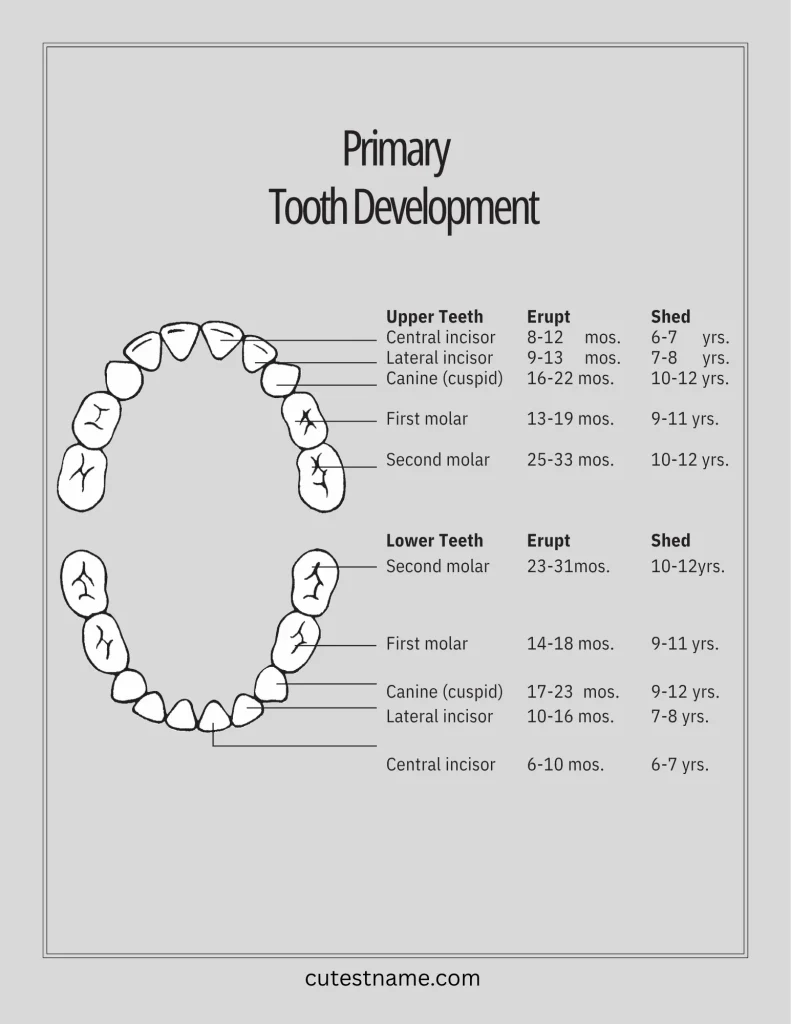
Baby Teeth Eruption Age Table
Baby teeth are also called primary teeth or temporary teeth. They usually begin appearing around 6 months of age, and most children have all 20 by about age 3. The exact timing can vary.
| Baby tooth | Upper teeth erupt | Lower teeth erupt |
|---|---|---|
| Central incisor | 8–12 months | 6–10 months |
| Lateral incisor | 9–13 months | 10–16 months |
| First molar | 13–19 months | 14–18 months |
| Canine | 16–22 months | 17–23 months |
| Second molar | 25–33 months | 23–31 months |
These are typical eruption ranges, not exact deadlines.
Baby teeth finally fall out to make room for permanent teeth. Most are shed between ages 6 and 12.
Permanent Teeth Eruption Age Table
Permanent teeth usually appear in stages. The first molars and lower central incisors often come in around age 6, while wisdom teeth may appear much later. Some wisdom teeth never erupt into the mouth.
| Permanent tooth | Upper teeth erupt | Lower teeth erupt |
|---|---|---|
| Central incisor | 7–8 years | 6–7 years |
| Lateral incisor | 8–9 years | 7–8 years |
| Canine | 11–12 years | 9–10 years |
| First premolar | 10–11 years | 10–12 years |
| Second premolar | 10–12 years | 11–12 years |
| First molar | 6–7 years | 6–7 years |
| Second molar | 12–13 years | 11–13 years |
| Third molar (wisdom tooth) | 17–21 years | 17–21 years |
Tooth Numbering System
Dental doctors use tooth numbering systems to identify individual teeth. In the United States, the permanent teeth are commonly numbered from 1 to 32. Primary teeth use letters A through T.
Other countries may use a different system, such as the FDI two digit system. The purpose is the same: to help dental professionals identify the exact tooth being discussed.
Common Teeth Problems
Common dental problems can affect any of the teeth names described above. They include:
- Tooth decay: Damage caused when acids from plaque wear away tooth structure.
- Gum disease: Infection and inflammation affecting the gums and supporting tissues.
- Tooth sensitivity: Pain or discomfort when teeth react to hot, cold, sweet, or acidic foods.
- Cracked or broken teeth: Damage that may happen from injury, chewing hard objects, or other causes.
- Impacted wisdom teeth: Wisdom teeth that do not fully emerge or become stuck under the gums.
If you have ongoing tooth pain, swelling, bleeding gums, or a broken tooth, a dental professional can help identify the cause and recommend treatment.
Tips to Keep Teeth Healthy
Good dental care helps protect your teeth and gums throughout life.
American Dental Association
- Brush twice a day: Use a soft-bristled toothbrush and brush for about two minutes each time.
- Clean between teeth: Floss or use another suitable interdental cleaner to remove plaque from places a toothbrush cannot reach.
- Choose tooth-friendly foods: Limit frequent sugary snacks and drinks, and eat a balanced diet.
- Replace your toothbrush: Change it every three to four months, or sooner if the bristles become worn.
- Visit your dentist: Regular checkups can help find problems early.
- Start early for children: Begin brushing as soon as the first baby tooth appears, and supervise young children as they learn.
FAQs
What are the 4 types of teeth called?
The four main types are incisors, canines, premolars, and molars. Each has a different shape and function.
How many teeth does an adult have?
Most adults have 32 permanent teeth, including four wisdom teeth. Some people have fewer because wisdom teeth may not erupt or may be removed.
How many baby teeth do children have?
Children usually have 20 baby teeth: 8 incisors, 4 canines, and 8 molars.
When do baby teeth start coming in?
The first baby teeth usually appear around 6 months of age, although the timing varies from child to child.
What are wisdom teeth?
Wisdom teeth are the third molars at the back of the mouth. They are the last permanent teeth to develop and may become impacted or fail to erupt.
Do premolars grow in baby teeth?
No. Premolars are only part of the permanent dentition. Baby teeth have molars in the spaces where premolars later appear.
Conclusion
Understanding the teeth names helps you understand your mouth, from the cutting action of incisors to the grinding work of molars. You also now know the basic parts of a tooth, the difference between baby and permanent teeth, and the usual ages when they appear.
A simple teeth diagram can make these ideas even easier to remember. If you want to learn more about your own teeth, ask your dental to explain your tooth chart at your next visit.